

Fin de Camino
The end is where we begin again

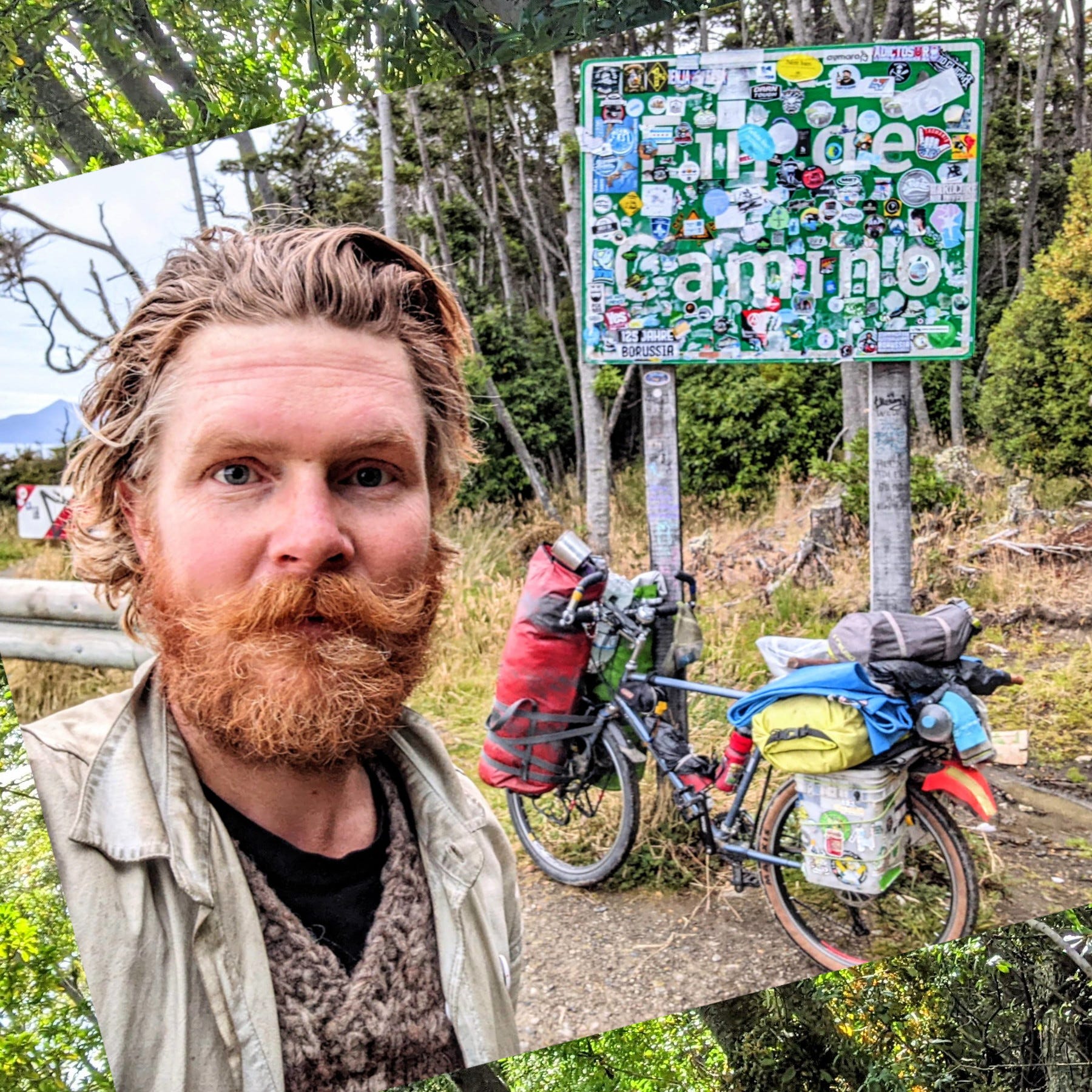
Fin de Camino (end of the road) is the southern terminus of all roads on the South American continent hell yeah! and about one day of riding from Punta Arenas Chile. This was a special spot for me, not least of all because no one else was talking about it.
When I first noticed the Fin de Camino during a map research session a month or so ago it gave me a pleasant tingle. Well well well what’s this?
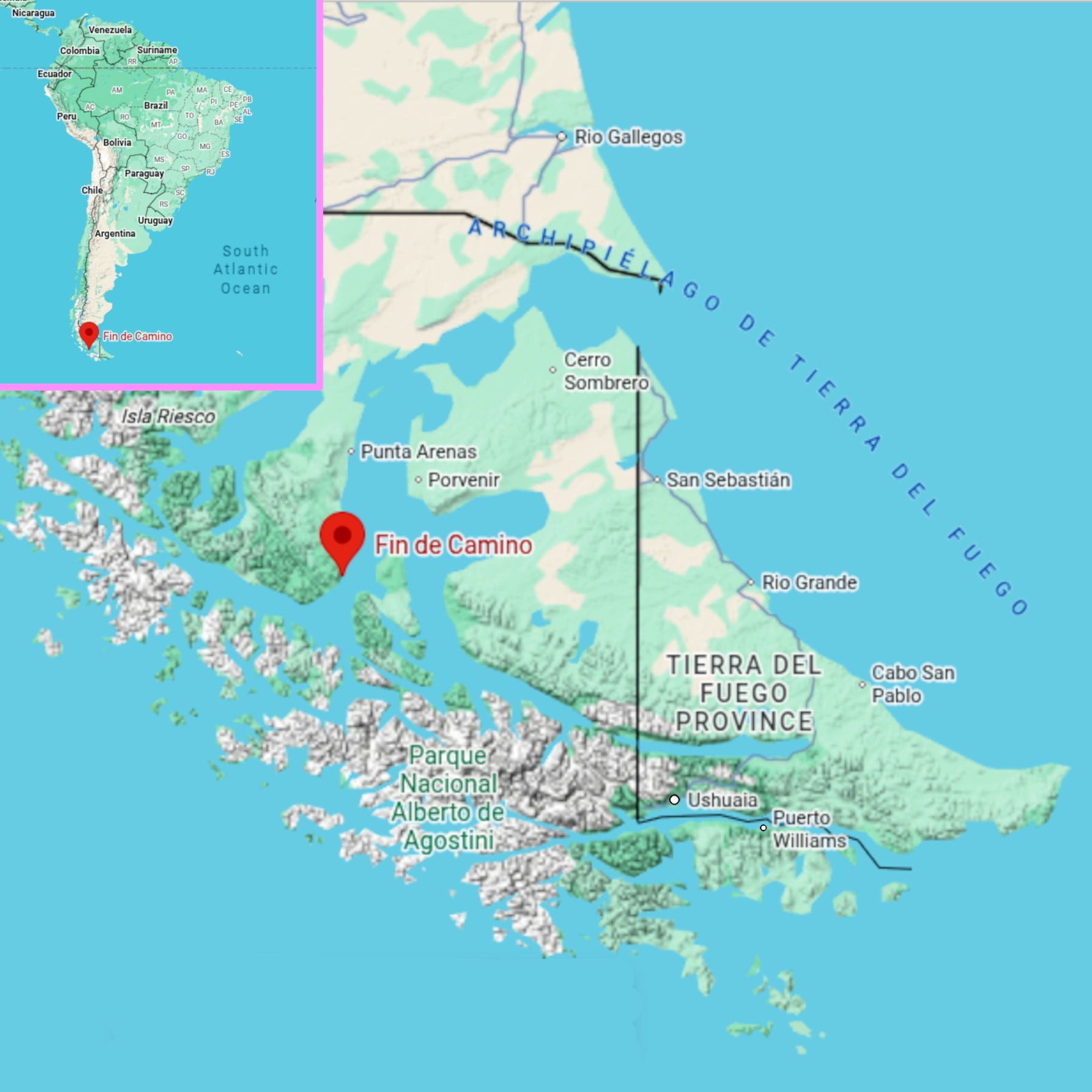
More frequently than not, conversations with other cyclists and many tourists down here in general focus on ‘Ushuaia! Ushuaia! Ushuaia!’. I get it and frankly do it a bit myself.
Super big ups to paying contributors for pitching in to feed me and to all my free subscribers for making the time to see me
❤️💚🖤💛🤍🤎
Paid Substack are a big boost, so are contributions to my go go go go Time for Patagonia GoFundMe or via venmo and paypal
For whatever it is worth, I do my best to spend the money on enterprising locals and at local markets by purchasing their food and utilizing the critical services on offer (read: bike shops and campsites).
Bikes are cool 🌎🚲🧊
Ushuaia is of course fun to say, furthermore it does hold the distinction of southernmost spot with a fairly large population *at last count 82,615*. Also it has a strong marketing campaign and something of a cult status among travelers plus a big airport because yes, at some or many points, most if not all touring cyclists pack their bikes into boxes and take to the sky. And yet, there is another town even further south, Puerto Williams Chile, across the Beagle Channel on a different island that you can visit by purchasing a very expensive ferry ticket. At last count it was home to 2,874 people. It is easy to get swept along into some of this foolish fervor and supposing you’ve got the cash to buy that pricey ticket to Puerto Williams probably you too will feel compelled to say that you have gone all the way!
Along these lines, if you mention Ushuaia to a Chilean there is a very good chance they will immediately make sure you are aware of Puerto Williams and when you read the wikipedia pages for Punta Arenas Chile, Ushuaia Argentina and Puerto Williams Chile each makes their case for why they are in fact the world’s southernmost city. Chile and Argentina sometimes remind me of outrageously rich and distinguished siblings constantly trying to outdo each other. We could equally well make reference to their awesome unique cultures but just from the little I have seen, the natural beauty in both countries, all by itself, is immense, diverse and astounding.
Ushuaia and Puerto Williams may very much exhibit the spirit of their respective countries and South America as a whole, however they are not part of the continental land mass. Ushuaia is on the island of Tierra del Fuego and Puerto Williams is on Navarino Island. Both are fine places I am sure but, in the case of Ushuaia specifically, it ends up feeling like the charismatic idol of a cult. Everybody else is going bro. Aren’t you going? Race me to the bottom bro. Why aren’t you there already?
Ok. Fine. Whatever.
I’ve been riding my bike on a road in South America since taking boats through the San Blas islands north of Panama in the Caribbean Sea to skip the Darién Gap. For me the road here started on a dock in Necoclí Colombia (8.420030772410556, -76.78202990079083). Now it has been over a year and a half of meandering my way south and up until kind of recently I wasn’t even planning to come down to Patagonia. I was going to take a left at Santiago and ride to catch the sailing season out of Brazil. Obviously that’s not what ended up happening. I changed my mind largely because I’d accidentally caught the southern summer season and it seemed like coming down to Patagonia now would be 100 thousand times easier than planning to do it later. From my current perspective that has proven to be a good idea.
So until farther notice pedaling to the Fin de Camino felt like a moment of personal closure, something significant to me that I came upon without outside suggestion. A literal and poignant period for perhaps my longest ever run-on sentence.
The trip down from Punta Arenas was very chill. I left early afternoon without a complete plan just figuring I could pull up short and camp if need be or maybe make the full distance before it got dark then camp. I recently made a big custom upgrade to my bike, which I’ll cover specifically in a different post, so this ride was also a bit of a shake down to test out my newly installed part.
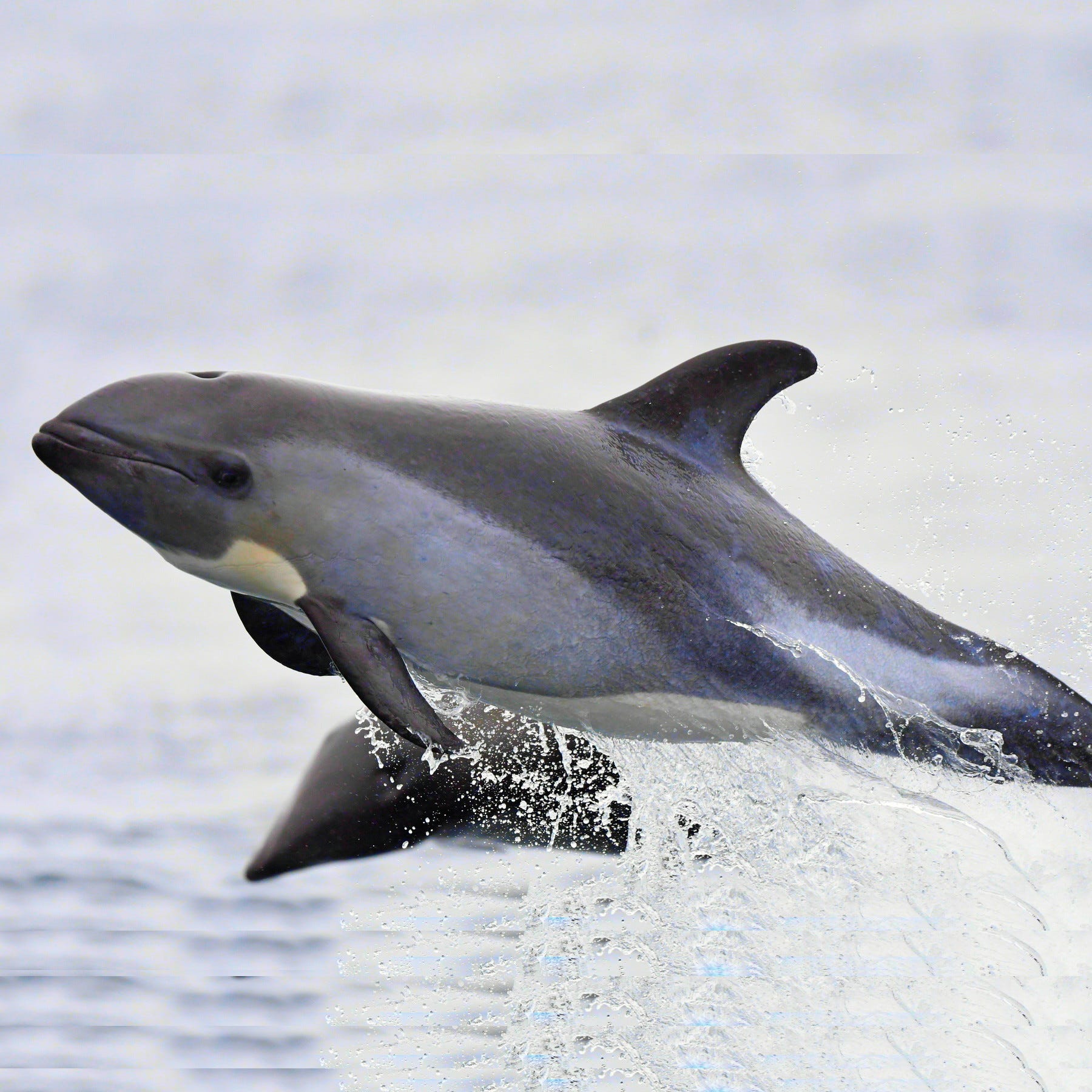
The sky was cloudy, road clean. The smell of ocean diffused into the cool air. With the Strait of Magellan on my left shoulder I found the way mostly flat with a few rolling hills and there wasn’t much wind. I stopped more than once to watch Peale’s dolphins cavorting in the kelp just beyond the shore. The water here is salty and tidal but buffered by land on every side and therefore very tranquil, similar in certain ways to the Puget Sound. Rain threatened to fall from the moody clouds but only ever arrived in light spatters. I passed sleepy villages and eventually stopped for a hot coffee, creamy and sweet.
Here is a short shaky clip of probably Peale’s dolphin (Cephalorhynchus australis). I saw them swimming in groups, moving parallel to the shore. At times they were leaping clear out of the water and coming back down again with a smack. Adults weigh about 115 kg (254 lb) and can grow to 2.1 m (6 ft 11 in). Click this link if you want to listen to a podcast all about them. *It also happens to contain a hearty dose of British propaganda in regards to the disputed Falkland Islands/Islas Malvinas*
Further on the asphalt wrapped into a roundabout and from there on the road was reasonably good gravel dotted with a number of free camping possibilities. On a bluff to the left is the reconstructed fort of Fuerte Bulnes. Founded in 1843 on a rocky hill at Punta Santa Ana, and named after President Manuel Bulnes Prieto. The fort was built to further the president’s colonization policies in Southern Chile and protect the Strait of Magellan. He directed construction to ward off claims by other nations.
Although the president wanted to establish a town, the harsh weather here prevented attracting a large and stable population. As a result, after six years, the local governor founded Punta Arenas in the Sandy Point area in 1848. Once people had migrated there, military forces abandoned and destroyed the fort. Between 1941 and 1943, the government directed the fort to be reconstructed as a historic monument. The replica includes the church, chaplain’s quarters, jail, powder magazine, post office and stables. It was declared a national monument in 1968. Today, it is administered by a private company. I could see it in the distance but had no plans to visit.
The sun began setting as my tires started to crunch. I did a little brake test and wondered if I’d find a decent place for my tent all the way down. I kept passing quite good ones and some people, cows, dogs and horses too. Maybe the end would be just a parking lot and not good for camping. I knew there was a hiking trail departing from there but not if I could use my bike on any part of it. Also my free camping app didn’t show any campsites along that trail. No matter, I was very close, time to keep going.
After crossing a short bridge over the languid Río San Juan the road rejoined the beach and for a small stretch was composed of packed sand. I passed more campsites, most of them empty, until I came round a final corner and spotted a cluster of green signs in the distance. No need to speed up, so instead I slowed down. Stroke by stroke the hip high red line of the terminal barrier took on greater body and distinction. Finally, the road slightly widened and a few empty cars were parked on either side. I passed the first and second green signs before dismounting the bicycle and leaning it against the last.
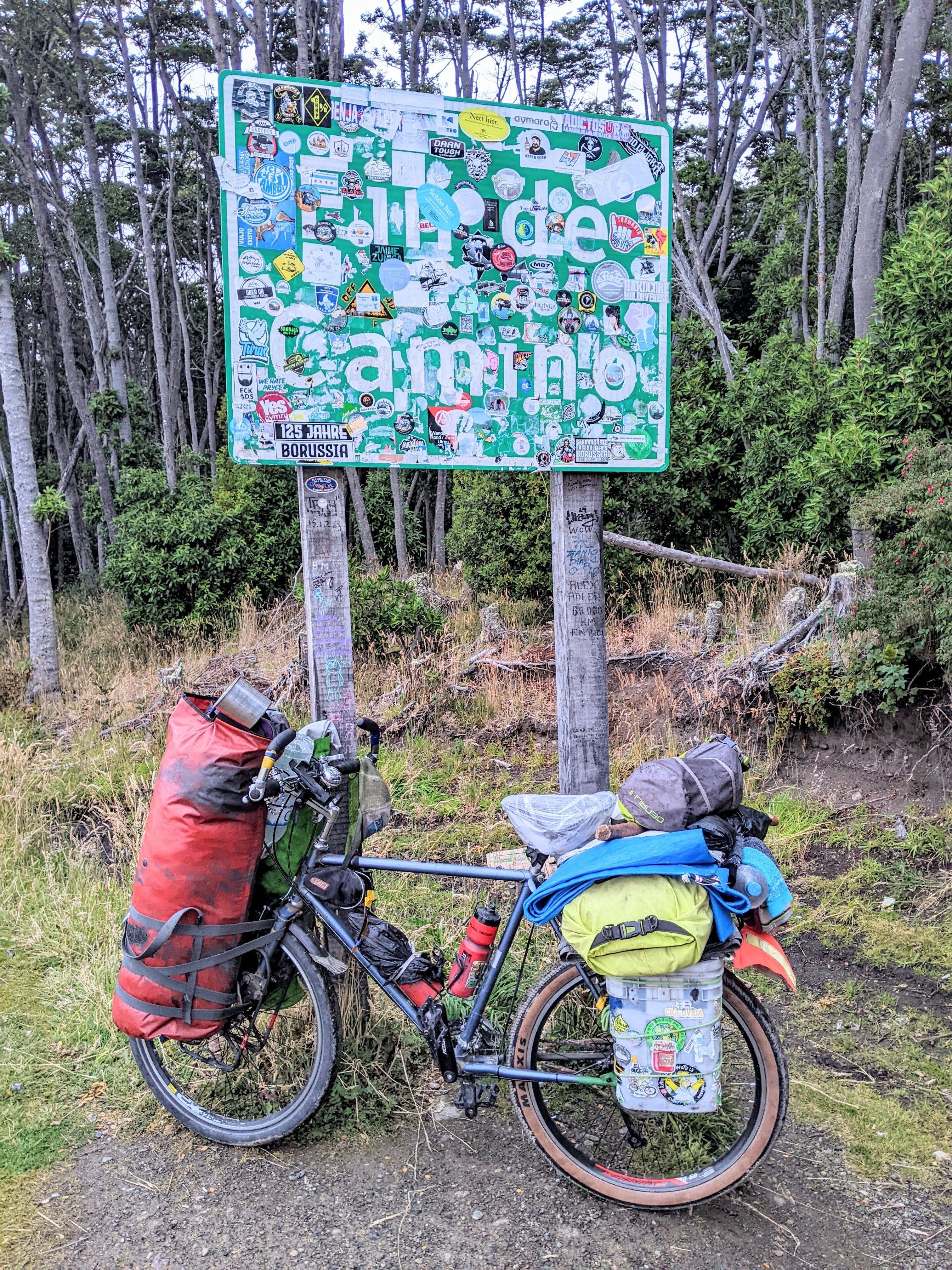
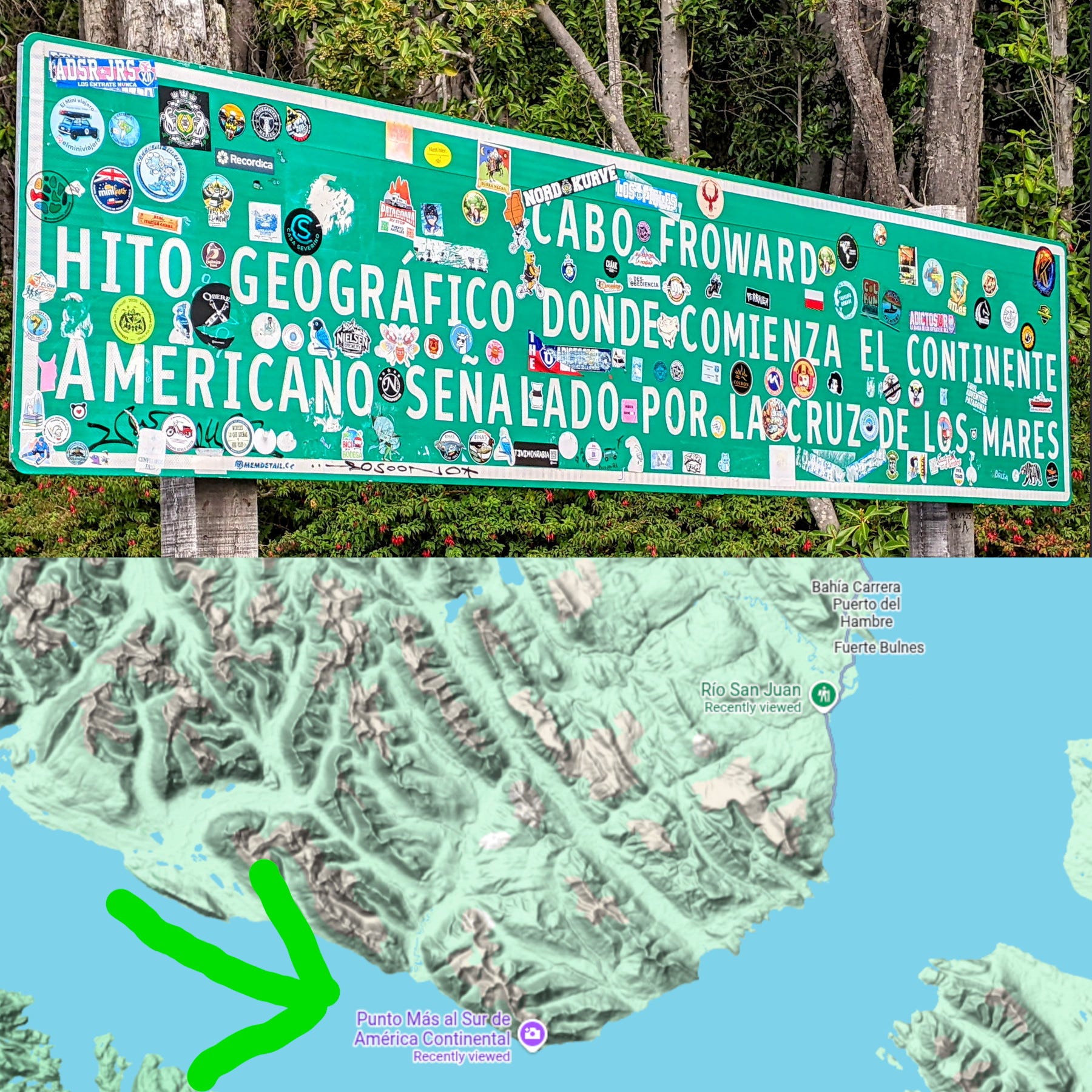
With the support from a huge community of disparate people, many of which are following along here and many more that I have met along the way, two wheels, two eyes, two ears, two hands, two arms, two feet, two legs and perhaps a little too much stuff we carried me all the way down to the bottom. Fin de Camino. The end of the road.
I had no service on my phone to call and no one was there to greet me. No baskets of fruit and banners awaited, only the rustling of leaves and the sounds of water gently lapping pebbles on the beach. I stood patiently waiting for nothing in particular and as is my way in situations that seem to mark transformation or in the observation of moving natural beauty, I took 5 slow breaths with the intention to gather all sprawling existence into the presence of a fleeting moment. A still point for all the moving worlds.


After my space for reflection and a few selfies done it was time to find a camp. Going back the way I came right away wasn’t that appealing but the first part of the hiking trail was wide and firm. Even though no established spots were known to me it felt fitting to pass the barrier and go beyond the road. Drops of rain began to fall again and light was in short supply. The bike bumped along over lumpy stones and the forest thick to my side. I figured the beach itself could make due but kept plodding until I passed the first turn and just thereafter found the forest opening into a perfect grassy grove. Bingo! ¡Que bueno! Let’s do this.
I woke up to a sunny morning, packed the camp onto my bicycle and then went on a short scramble hike to a local lookout point. With a view back out over the water and the islands beyond, I found myself in a thicket abuzz with birdies. So far as I can tell this is a tree party of feeding Patagonian Sierra Finches. Hear is higher fidelity audio recording of them from roughly the same region taken by one Peter Boesman.
https://xeno-canto.org/species/phrygilus-patagonicus
On the vista, I found a plaque detailing some of the hunting and gathering practices of the original human inhabitants of this land but that specific version of their existence has long since been destroyed. Punta Arenas and surroundings were originally inhabited by indigenous, nomadic groups—specifically the Kawésqar (Alacalufes) and Selk’nam (Onas) along with Aonikenk/Tehuelches and Yagán. But their numbers were decimated after the arrival of Europeans from both diseases and intention. The Museo Maggiorino Borgatello in Punta Arenas contains some artifacts and images of them in photos. I could imagine them ranging about this rich terrain and settling amongst the trees.


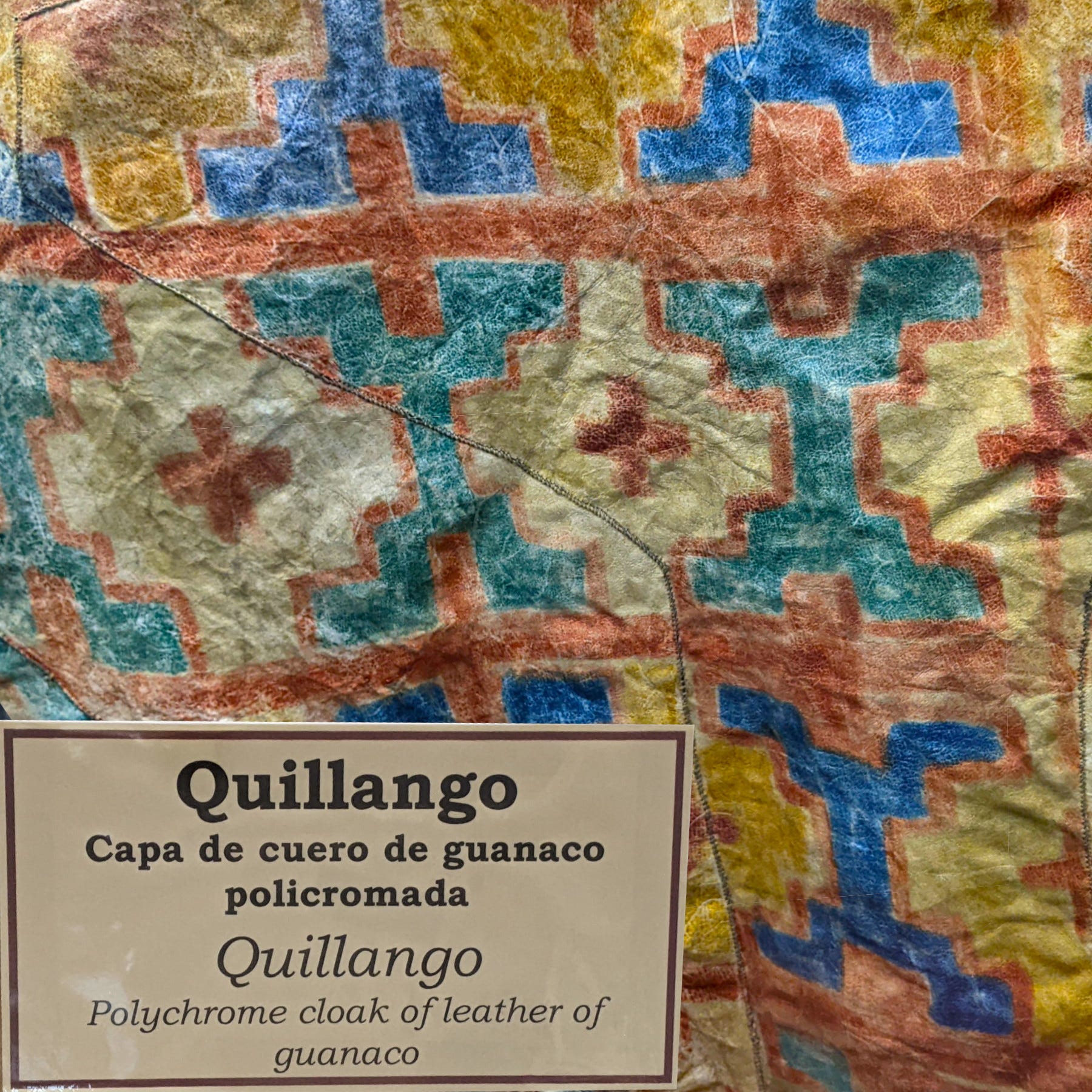
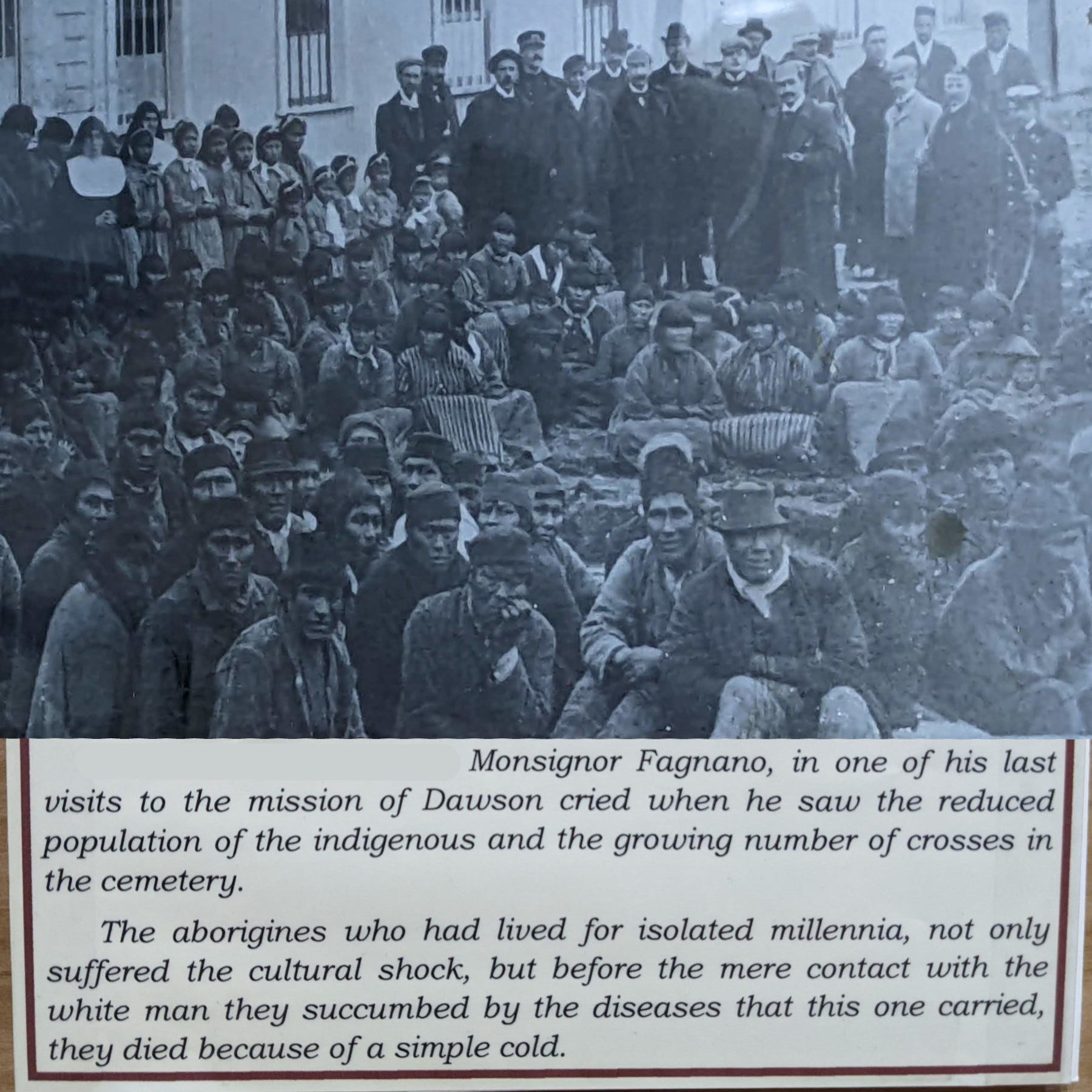
You can read about Yokcushlu (c. 1821 – c. 1883) a Kawésqar woman from the western Tierra del Fuego here. In 1830, at the age of nine, she was taken hostage by the crew of the British vessel HMS Beagle and renamed “Fuegia Basket”. Robert FitzRoy, captain of the Beagle, initially intended to trade her for a stolen boat.
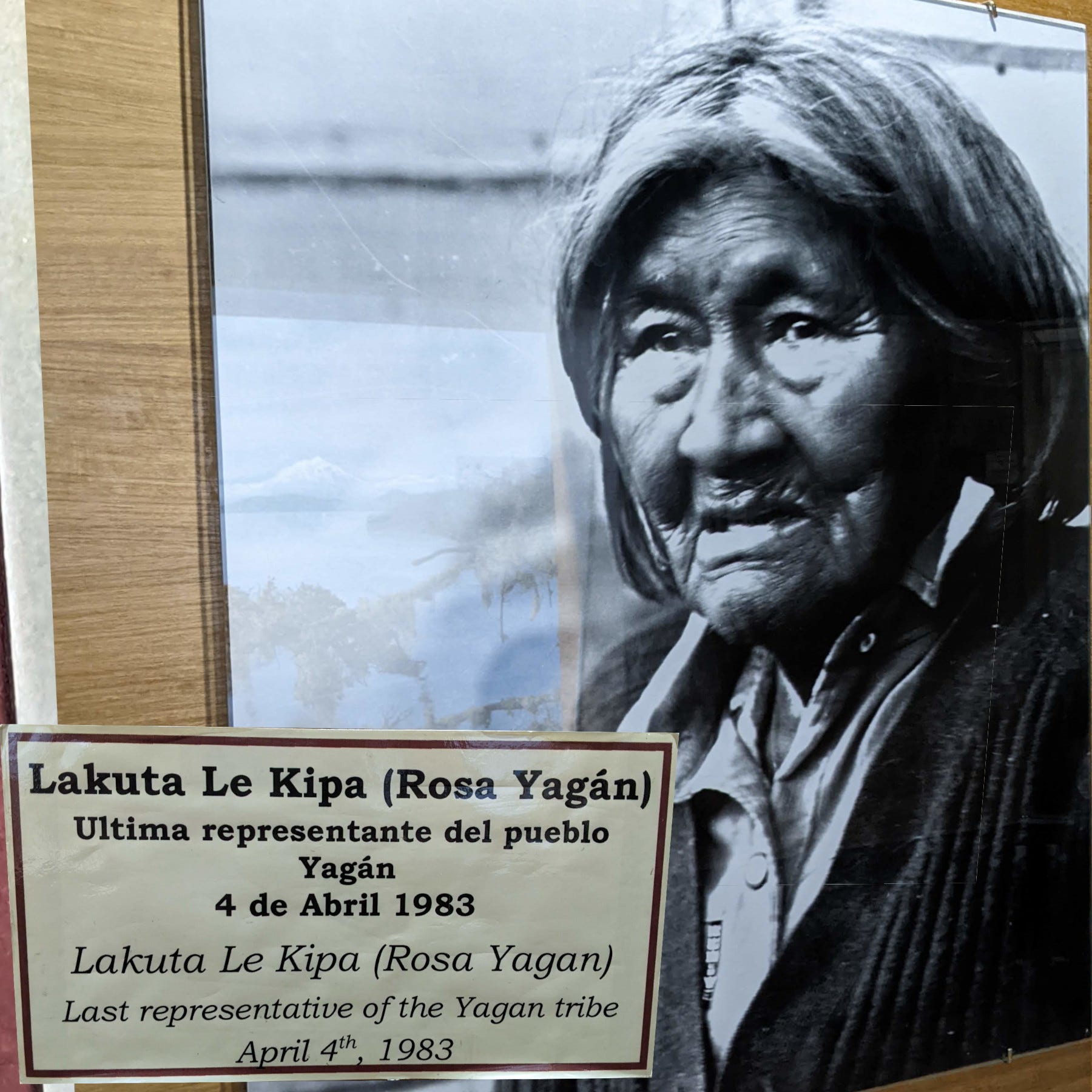
I felt very honored to have spent some time here as a visitor and can only wonder at their deep understanding of this fantastic land. Many representatives from these societies are alive and well today but their traditional ways and the territory upon which they have existed are many generations heavily pressed upon. I share their historical images here with the intention of showing them some respect and as a reminder that no one gets to choose all the great changes which are always in store.
Thank you for being here with me. Take good care.
joshua aka ukodus
What a well written story of your time in the tip. I really appreciate your highlight of the native people to the area. Lovely birdsong! Congrats on getting down there!!!
congratulations on reaching this defining point. Excited to hear about where you go from here as well as your custom bike upgrade!